
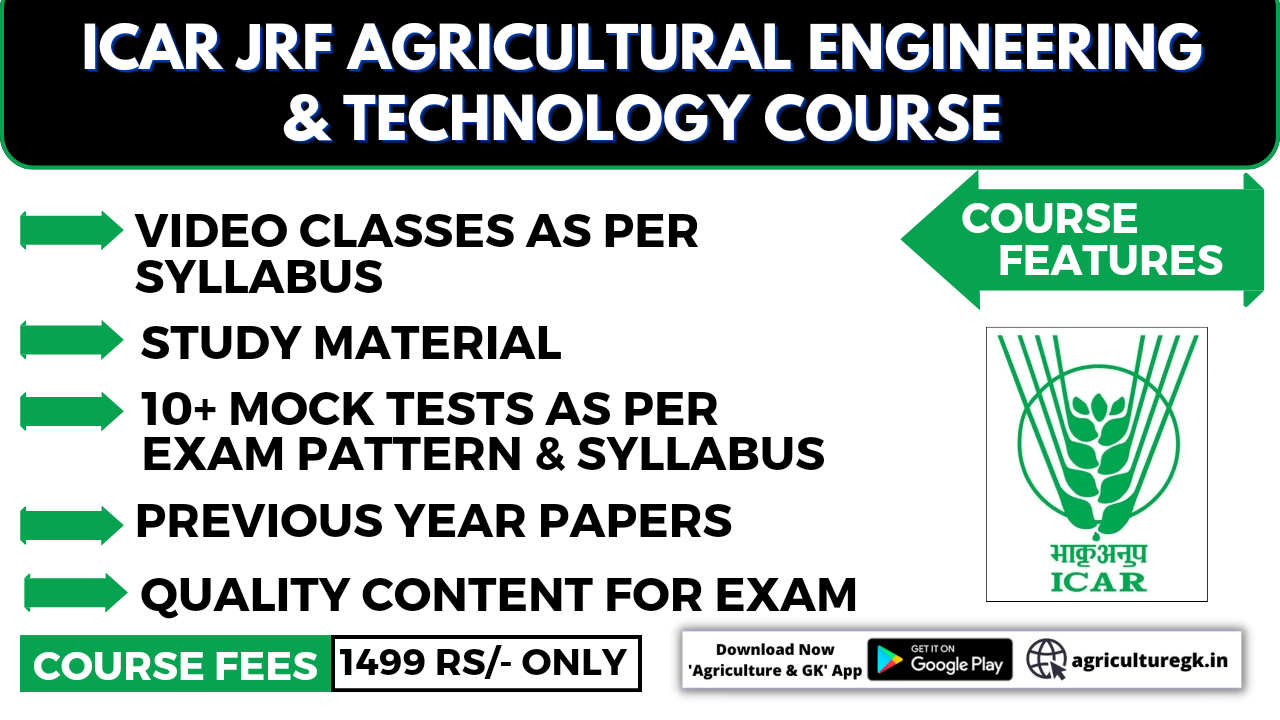
ICAR JRF Agricultural Engineering & Technology Exam Study Material/Course
Features
- Recorded Session
- Downloadable PDF & Video
- Test Series
- Quality Content with Best Learning Experience
- Subjesct wise Classes By Expert Faculty
Description
ICAR AIEEA PG Online Test Exam Pattern (CBT)
ICAR JRF Exam will be a single paper of 480 marks. The paper will be a computer-based test and you will be given a total of 120 minutes to solve the entire paper. Candidates will have the option to change previously saved answers of any question, anytime during the entire duration of the test. Detailed ICAR JRF exam pattern has been provided below.
|
Mode of Examination |
No. of Questions |
Maximum Marks |
Duration |
Exam Language |
Questions Type |
|
CBT (Computer Based Test) |
120 questions |
480 marks |
2 hours |
English Only |
Multiple Choice Questions |
ICAR JRF PG AGRICULTURAL ENGINEERING & TECHNOLOGY SYLLABUS
MAJOR SUBJECT GROUP - AGRICULTURAL ENGINEERING AND TECHNOLOGY
(Sub-Subjects: 10.1: Soil & Water Conservation Engineering, 10.2: Irrigation and Drainage Engineering 10.3 Processing and Food Engineering 10.4: Farm Machinery and Power Engineering 10.5: Renewable Energy Engineering)
UNIT-I : Elementary Statistics and theory of probability, differential and integral calculus, linear algebra and Fourier series, differential equations, vector algebra & vector calculus, elementary numerical analysis.
UNIT-II: Electric motors: Types, performance, selection, installation and maintenance, measuring instruments, fundamentals of computers, power distribution.
UNIT-III: Thermodynamic principles; fluid mechanics, theory of machines.
UNIT-IV: Soil mechanics, soil classification, compaction & shear strength of soils, engineering mechanics, strength of materials.
UNIT-V: Importance of farm equipment and role of mechanization in enhancing productivity & profitability of Indian agriculture; analysis of forces, design and production of farm machinery and power units; mechanics of tillage & traction operation, repair and maintenance of farm machines and equipment, farm engines; tractors and power tillers; tractor stability and operators comfort; field capacity and cost analysis; test codes and procedure; safety and ergonomic principles. Role of energy in economic development; solar, wind and bio-energy; biogas plants & gasifiers; biofuels from biomass; collection, characterization and storage of biomass, solar cookers & solar refrigerators.
UNIT-VI: Biochemical and engineering properties of biological materials; quality control & safety of raw and finished products. Principles, practices and equipments for drying, milling, separation and storage of agricultural produce and by-products; material handling equipment and operations; farmstead planning; heating & cooling load calculation; seed processing practices and equipments; food preservation methods and products development; refrigeration and air conditioning; cold stores; waste management, cost analysis & food processing plants layout, feasibility reports.
UNIT-VII: Surveying and leveling; hydrology, water resources in India; efficiency in water use; irrigation system and equipment; water conveyances and associated efficiency; soil-plant-water relationship; estimation of evaporation and water requirements of crop; water harvesting and use, farm ponds and reservoirs, command area development, land use capability classification, ground water development, wells and pumping equipment, soil erosion and its control, land shaping and grading equipment and practices, hydraulic structures, drainage of irrigated and humid areas; salt balance and reclamation of saline and alkaline soils.