Haryana Agricultural Development Officer (HPSC ADO) Exam Complete Course
Validity: 12 Months
₹2,699
₹30,000
Choose Currency:
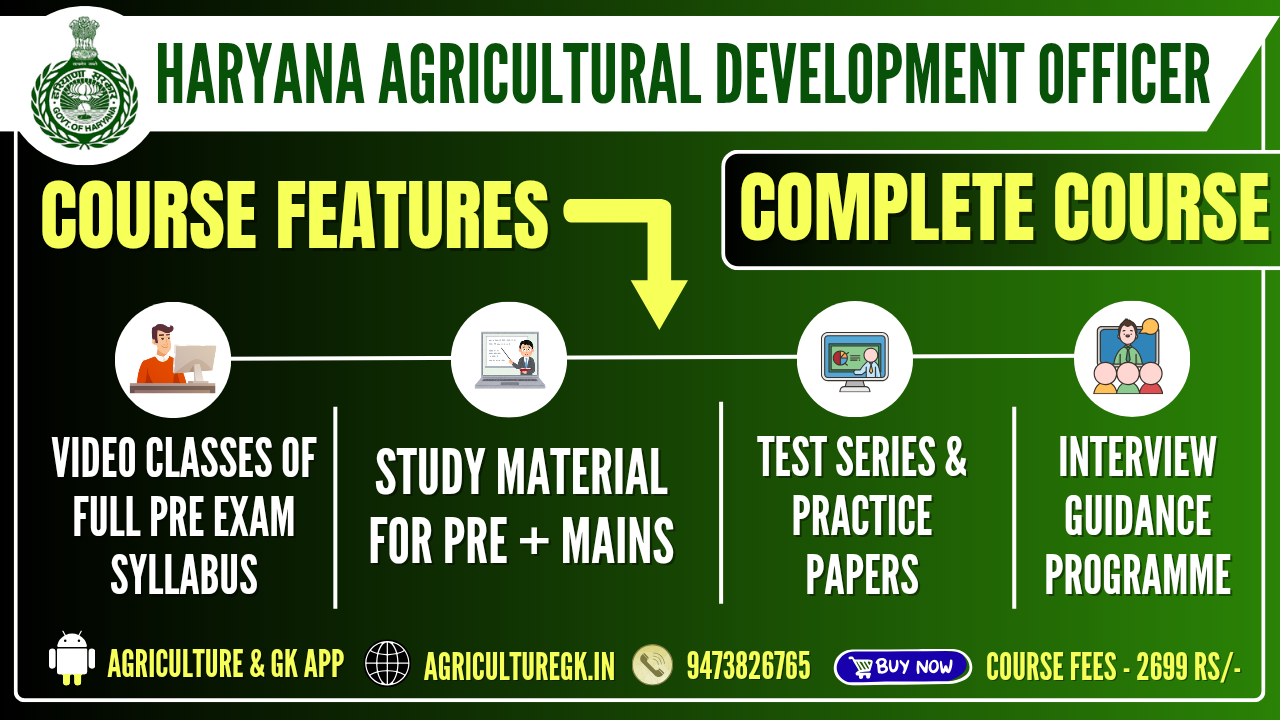
Features
- Live & Recorded Classes
- Study Material & e-Books
- Test Series & Practice Papers
- Complete Coverage of Prelims & Mains Exam
- Interview Guidance Programme
Description
|
SUBJECTS COVERED IN OUR COURSE |
|
|
Screening Test -
|
Subject Knowledge Test -
|
HPSC ADO EXAM PATTERN FOR SCREENING TEST
The Screening Test is an offline OMR-based MCQ exam with 100 questions worth 1 mark each. It covers General Awareness, Reasoning Ability, and Haryana-specific knowledge. Candidates face 0.25 marks negative marking for every wrong or unmarked answer. There are 5 options per question, with the 5th being “unattempted”. If more than 10% questions remain unattempted, the candidate is disqualified. The test lasts 2 hours, and scoring at least 25 marks (25%) is mandatory to qualify.
|
HPSC ADO Exam Pattern for Screening Test |
|
|
Particulars |
Details |
|
Exam Mode |
Offline (OMR-Based) – MCQ format |
|
Total Questions |
100 |
|
Total Marks |
100 |
|
Marks per Question |
Equal marks for all questions |
|
Options per Question |
5 options (5th option for unattempted questions) |
|
Negative Marking |
0.25 marks deducted for each wrong or unmarked answer |
|
Disqualification Criteria |
More than 10% unattempted questions (no option darkened) |
|
Duration |
2 hours |
|
Minimum Qualifying Marks |
25% |
|
Shortlisting Criteria |
Candidates 4 times the advertised posts (with bracketed candidates) will qualify for the next stage |
HPSC ADO EXAM PATTERN FOR SUBJECT KNOWLEDGE TEST
The HSPC ADO Subject Knowledge Test is a 3-hour descriptive paper carrying 150 marks, entirely focused on Agriculture subjects. A minimum of 35% marks (52.5 out of 150) is required to pass. This stage has 87.5% weightage in the final merit calculation, making it the most decisive round. Candidates 2 times the number of vacancies (including bracketed candidates) are shortlisted from here for the interview.
|
HPSC ADO Exam Pattern for Subject Knowledge Test |
|
|
Particulars |
Details |
|
Exam Mode |
Descriptive |
|
Total Marks |
150 |
|
Duration |
3 hours |
|
Minimum Qualifying Marks |
35% |
|
Weightage in Final Merit |
87.5% |
|
Shortlisting Criteria |
Candidates 2 times the advertised posts (with bracketed candidates) will qualify for the interview |
HPSC ADO INTERVIEW PROCESS
The Interview carries 12.5% of the final merit and is scored out of 20 marks. It evaluates communication skills, analytical thinking, problem-solving ability, and practical agricultural knowledge. Only those who clear the Subject Knowledge Test are called for the interview. The final merit list is prepared by combining the Subject Knowledge Test (150 marks) and Interview (20 marks) scores.
|
HPSC ADO Interview Process |
|
|
Particulars |
Details |
|
Interview Weightage |
12.5% |
|
Evaluation Criteria |
Communication skills, problem-solving ability, practical agricultural knowledge, and overall personality |
|
Final Merit Calculation |
Based on Subject Knowledge Test + Interview |
HPSC ADO SYLLABUS
The HPSC ADO Syllabus is designed to test both the general aptitude and agricultural expertise of candidates. It covers diverse topics spread across three stages – Screening Test, Subject Knowledge Test, and Interview. While the Screening Test focuses on general awareness, reasoning, and Haryana-related knowledge, the Subject Knowledge Test dives deep into agriculture-specific disciplines. A thorough understanding of the syllabus ensures focused preparation and higher chances of securing a top rank.
HPSC ADO SYLLABUS FOR SCREENING TEST
The Screening Test syllabus is broad and includes General Awareness, Reasoning Ability, Quantitative Aptitude, English Language, and Haryana GK. It is intended to evaluate a candidate’s overall aptitude, state-specific awareness, and problem-solving skills. Covering each area strategically can help candidates clear this stage and move forward to the Subject Knowledge Test.
|
HPSC ADO Syllabus for Screening Test |
|
|
Section |
Key Topics |
|
General Awareness |
Current events (National & International), Important Days, Books & Authors, Awards, Indian Polity, Economy, Geography, Sports |
|
Reasoning Ability |
Analogies, Classification, Series, Coding-Decoding, Blood Relations, Direction Sense, Puzzle Test, Syllogism |
|
Quantitative Aptitude |
Number System, Ratio & Proportion, Percentage, Average, Profit & Loss, Simple & Compound Interest, Time & Work, Data Interpretation |
|
Haryana GK |
History, Culture, Geography, Economy, Polity, Schemes, and Current Affairs of Haryana |
HPSC ADO SYLLABUS FOR SUBJECT KNOWLEDGE TEST
The Subject Knowledge Test syllabus is entirely agriculture-focused and requires in-depth knowledge of farming techniques, crop science, and allied agricultural subjects. It includes Agronomy, Soil Science, Horticulture, Plant Breeding, Irrigation, Pest Management, and more. This stage carries 87.5% weightage in the final merit, making it critical for selection.
|
HPSC ADO Syllabus for Subject Knowledge Test |
|
|
Topic |
Key Areas to Cover |
|
Ecology & Environment |
Relevance to humans; sustainable natural resource management; physical/social environment effects on crops; agroecology; cropping patterns as environmental indicators; environmental pollution impacts; climate change (conventions, initiatives, greenhouse effect, global warming); Remote Sensing (RS) & GIS. |
|
Cropping Systems & Farming Practices |
Cropping patterns in agro-climatic zones; effects of high-yielding/short-duration varieties; concepts of cropping/farming systems (organic, precision farming); package practices for cereals, pulses, oilseeds, fibres, sugar, commercial & fodder crops. |
|
Forestry |
Social forestry, agroforestry, natural forests; forest plant propagation; forest products & value addition; forest flora/fauna conservation. |
|
Weed Management |
Characteristics & dissemination of weeds; crop-weed associations; cultural, biological & chemical control methods. |
|
Soil Science |
Soil properties (physical, chemical, biological); soil formation; soils of India; mineral/organic constituents & productivity; essential nutrients; soil fertility; soil testing & fertilizer recommendations; integrated nutrient management; biofertilizers; nitrogen fixation & efficiency; phosphorus/potassium use; problem soils & reclamation; soil factors in greenhouse gas emissions. |
|
Soil & Water Conservation |
Soil erosion control; watershed management; dryland agriculture issues; rainfed area stabilization techniques. |
|
Irrigation & Water Management |
Water-use efficiency; irrigation scheduling; runoff reduction; rainwater harvesting; drip/sprinkler irrigation; drainage of waterlogged soils; irrigation water quality; industrial effluents’ impact on soil/water; major Indian irrigation projects. |
|
Farm Economics & Management |
Farm planning & resource use; budgeting; farming system economics; marketing strategies & intelligence; price fluctuations; cooperatives; agricultural price policy; crop insurance. |
|
Agricultural Extension |
Extension roles & methods; socio-economic surveys; extension worker training; Krishi Vigyan Kendras (KVKs); NGOs & SHGs in rural development. |
|
Genetics & Plant Breeding |
Cell structure/cycle; genetic material synthesis/structure/function; heredity laws; chromosome aberrations; polyploidy; mutations; heritability; cytoplasmic inheritance; sex-linked traits; history of plant breeding; reproduction modes; crop domestication; genetic resources; molecular markers; breeding methods; heterosis; somatic hybridization; resistance breeding; genetic engineering; GMOs. |
|
Seed Technology |
Seed production/processing; certification; testing/storage; DNA fingerprinting; seed registration; public/private seed marketing; IPR & WTO issues. |
|
Plant Physiology |
Nutrient absorption/translocation/metabolism; soil-water-plant relations; enzymes & pigments; photosynthesis (C3/C4/CAM); respiration; carbohydrate/protein/fat metabolism; growth regulators; photoperiodism; vernalization; seed development/germination; dormancy; stress physiology. |
|
Horticulture |
Major fruits, plantation crops, vegetables, spices, flowers; protected cultivation; high-tech horticulture; post-harvest technology; landscaping; floriculture; medicinal/aromatic plants; nutritional value of horticultural produce. |
|
Pest & Disease Management |
Pest/disease diagnosis & classification; IPM/IDM; biological control; epidemiology; quarantine measures; pesticide formulations & modes of action. |
|
Food Security & Policies |
Food production & consumption trends; food security vs. population; national/international food policies; PDS; BPL data; micronutrient deficiencies; women/children’s nutrition & work capacity; productivity & dietary guidelines; hunger elimination strategies. |
Demo Videos

STUDY GUIDE FOR HPSC ADO MAINS EXAM VOLUME -1 SAMPLE COPY
Haryana ADO Mains Paper Set - 1

History Lecture -1
Geography Part -1
Polity Part -1
Economy Part-1