ICAR JRF Community Science/Home Science Exam Study Material/Course
Validity: 12 Months
₹999
₹2,000
Choose Currency:
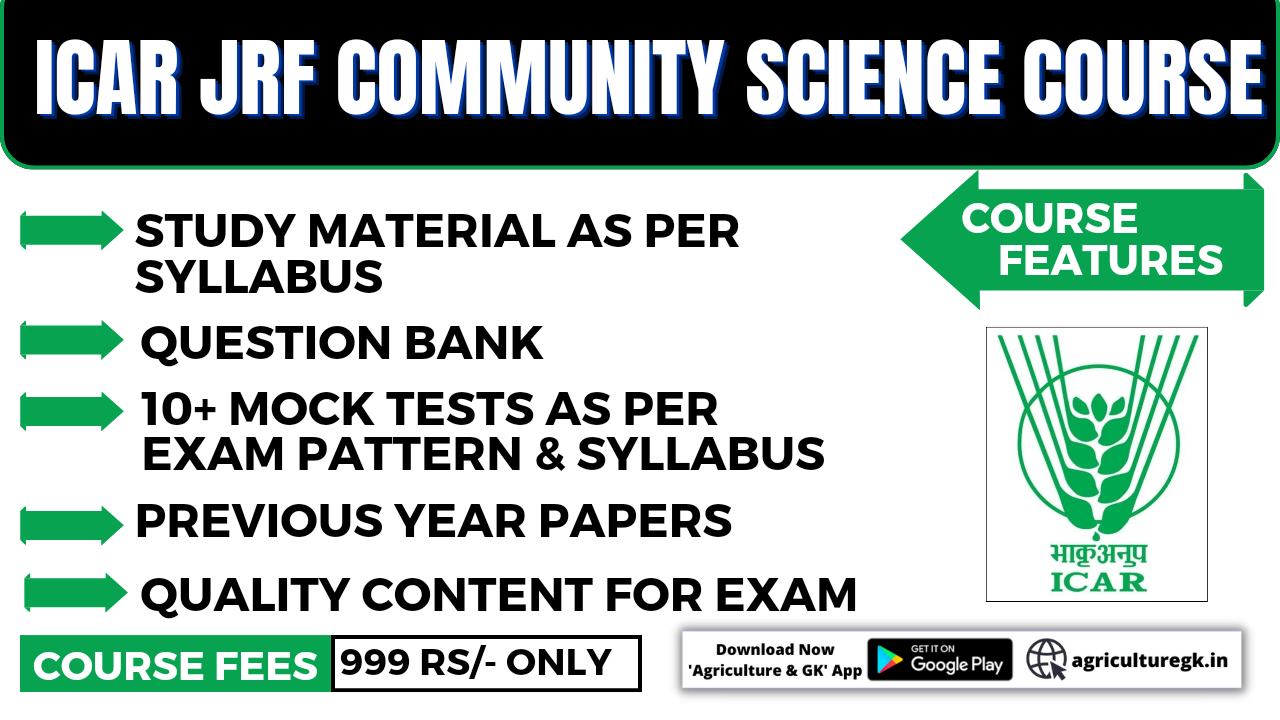
Features
- Complete Study Material Based on Syllabus
- Downloadable PDFs
- Test Series
- Quality Content as Per Syllabus
- One Question Bank(1500+ MCQs)
Description
ICAR AIEEA PG Online Test Exam Pattern (CBT)
ICAR JRF Exam will be a single paper of 480 marks. The paper will be a computer-based test and you will be given a total of 120 minutes to solve the entire paper. Candidates will have the option to change previously saved answers of any question, anytime during the entire duration of the test. Detailed ICAR JRF exam pattern has been provided below.
|
Mode of Examination |
No. of Questions |
Maximum Marks |
Duration |
Exam Language |
Questions Type |
|
CBT (Computer Based Test) |
120 questions |
480 marks |
2 hours |
English Only |
Multiple Choice Questions |
ICAR JRF PG COMMUNITY SCIENCE/HOME SCIENCE SYLLABUS
MAJOR SUBJECT GROUP – COMMUNITY SCIENCE (FORMERLY HOME SCIENCE)
(Sub-Subjects: 11.1: Food & Nutrition, 11.2: Human Development & Family Studies, 11.3: Resource Management and Consumer Science, 11.4: Apparel and Textile Science, 11.5: Extension Education and Communication Management)
UNIT-I: Importance of agriculture in national economy; basic principles of crop production; cultivation of rice, wheat, chickpea, pigeon-pea, sugarcane, groundnut, tomato, and mango. Major soils of India; role of NPK and their deficiency symptoms. General structure and function of cell organelles; mitosis and meiosis; Mendelian genetics. Elementary knowledge of growth, development, photosynthesis, respiration and transpiration; Elements of economic botany. General structure and function of carbohydrates, proteins, nucleic acids, enzymes and vitamins. Major pests and diseases of rice, wheat, cotton, chickpea, sugarcane and their management. Organic farming; biofertilizers; biopesticides. Recombinant DNA technology; transgenic crops. Natural Resources: forest, water, mineral, food, energy and land resources. Ecosystems. Biodiversity & its conservation. Environmental pollution. Environmental ethics. Important rural development programmes in India; organizational set up of agricultural research, education and extension in India. Elements of Statistics.
UNIT-II: Elements of Human Nutrition i.e. Food groups and the nutrients contributed by each group to the diet, composition and nutritive value of foods; food processing and preservation, meal planning i.e. principles menu planning for normal individuals for different age groups and at different stages of life, diet therapy, institutional food management, community nutrition and health, food related laws, policy and programmes in India. Organic and genetically modified foods.
UNIT-III: Introduction to child/human development-meaning, concept, principles, prenatal development (conception to child birth), care of new born, pre- natal and post natal care of mother, development of child in early and late childhood, early childhood education, adolescence, development and relationship with peers & family, marriage and family dynamics, meaning, definition of family life cycle, family welfare programmes in India, community education, child studies methods, participation in pre-school/crèche.
UNIT-IV: Concept and principles of management, management process, work, work environment, work simplification, fundamentals of housing, principles of design & home furnishing-selection, care and maintenance of accessories, equipments, furniture, paintings, family finance/ economics and consumer education. Functional interiors for special needs.
UNIT-V: Introduction to clothing construction- sewing machine its parts and use, preparation of fabric for lay out textile fiber-classification, processing/manufacturing method, clothing need of family members, household textile and consumers, weaving and hosiery, traditional textiles and embroideries of India, care of clothing and textile finishes, dying & printing. Organic dyes.
UNIT-VI: Introduction to Home Science Education communication and extension methods, programme planning & evaluation, entrepreneurial education, projected and non- projected aids (audio-visual aids) rural development programmes in India. Empowerment of women.